
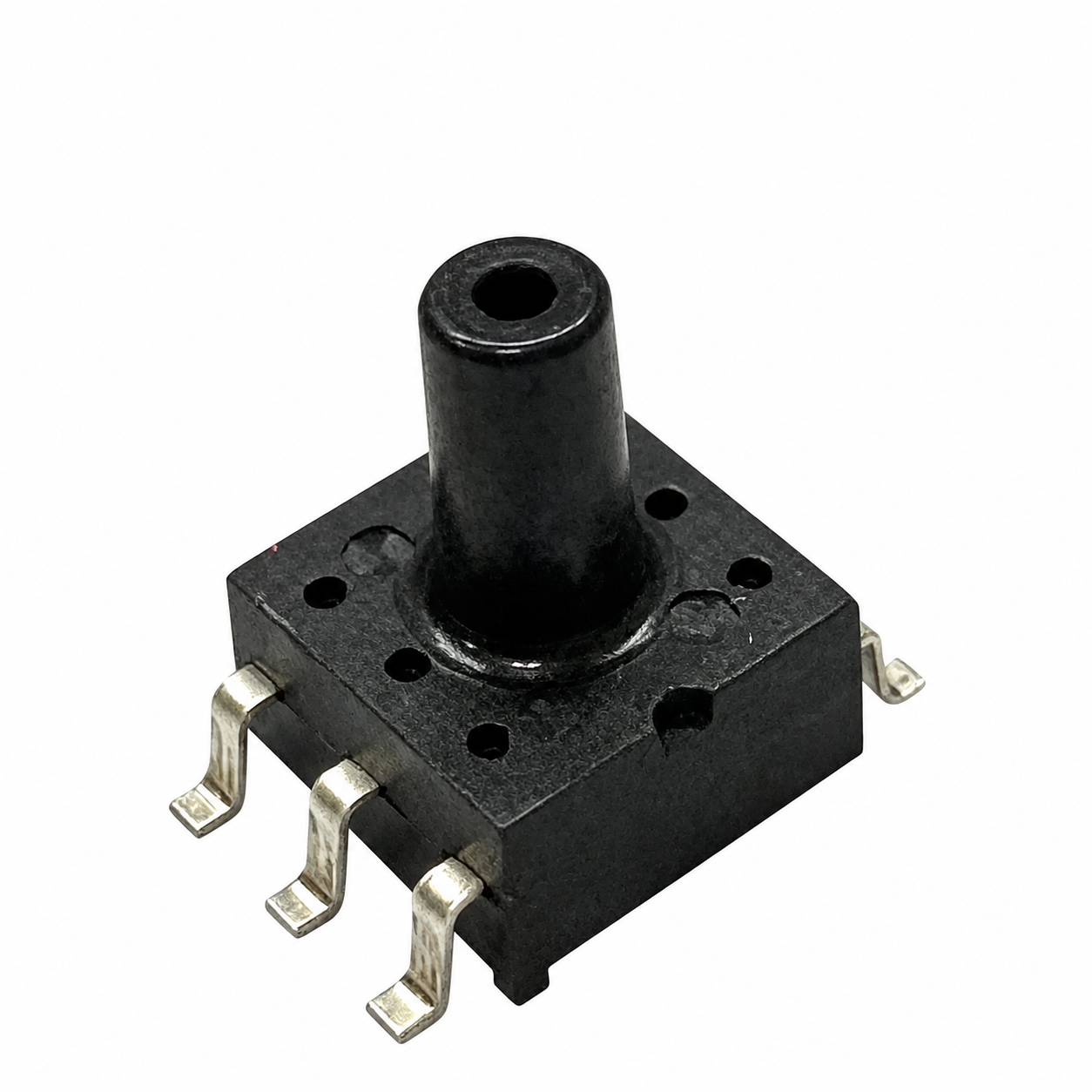
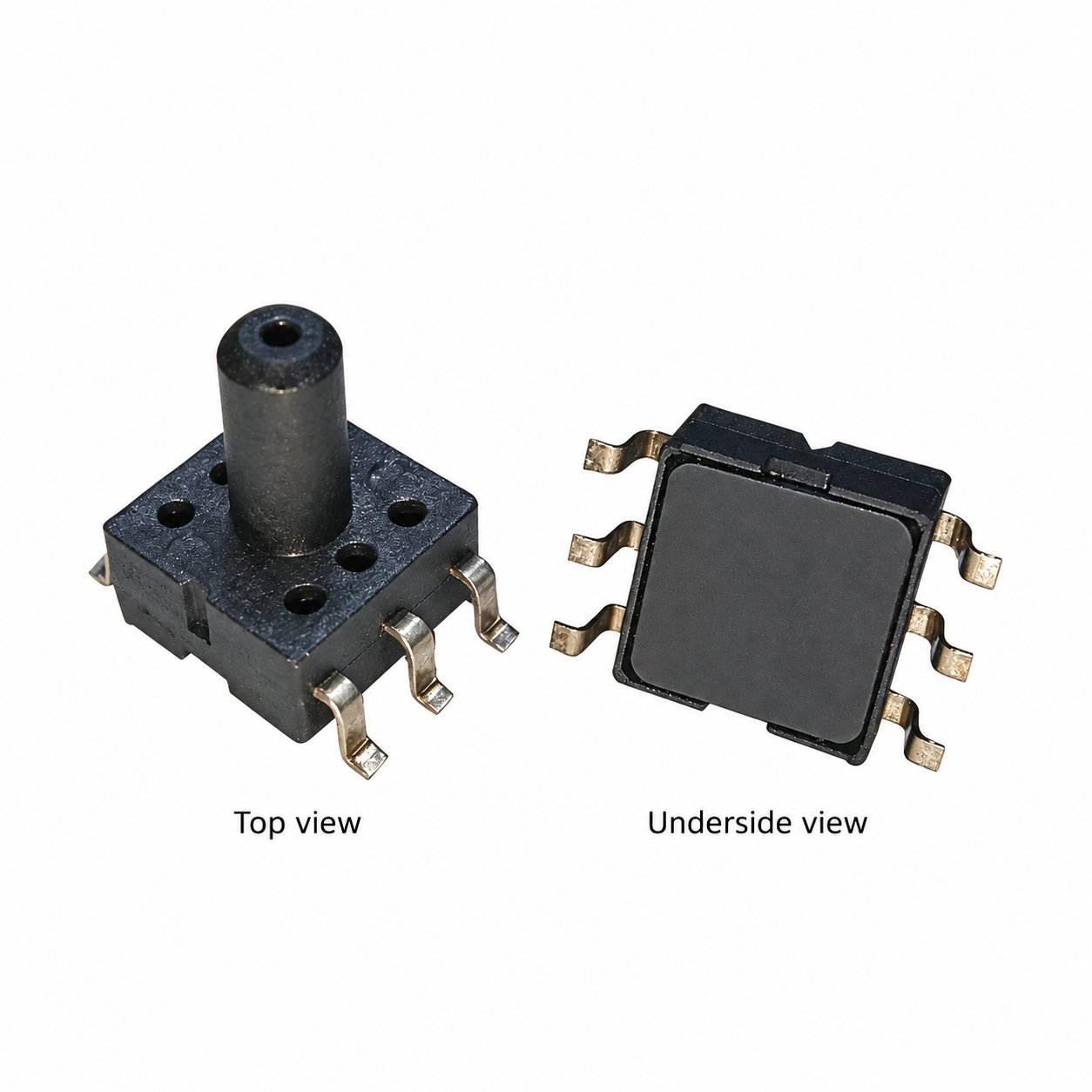
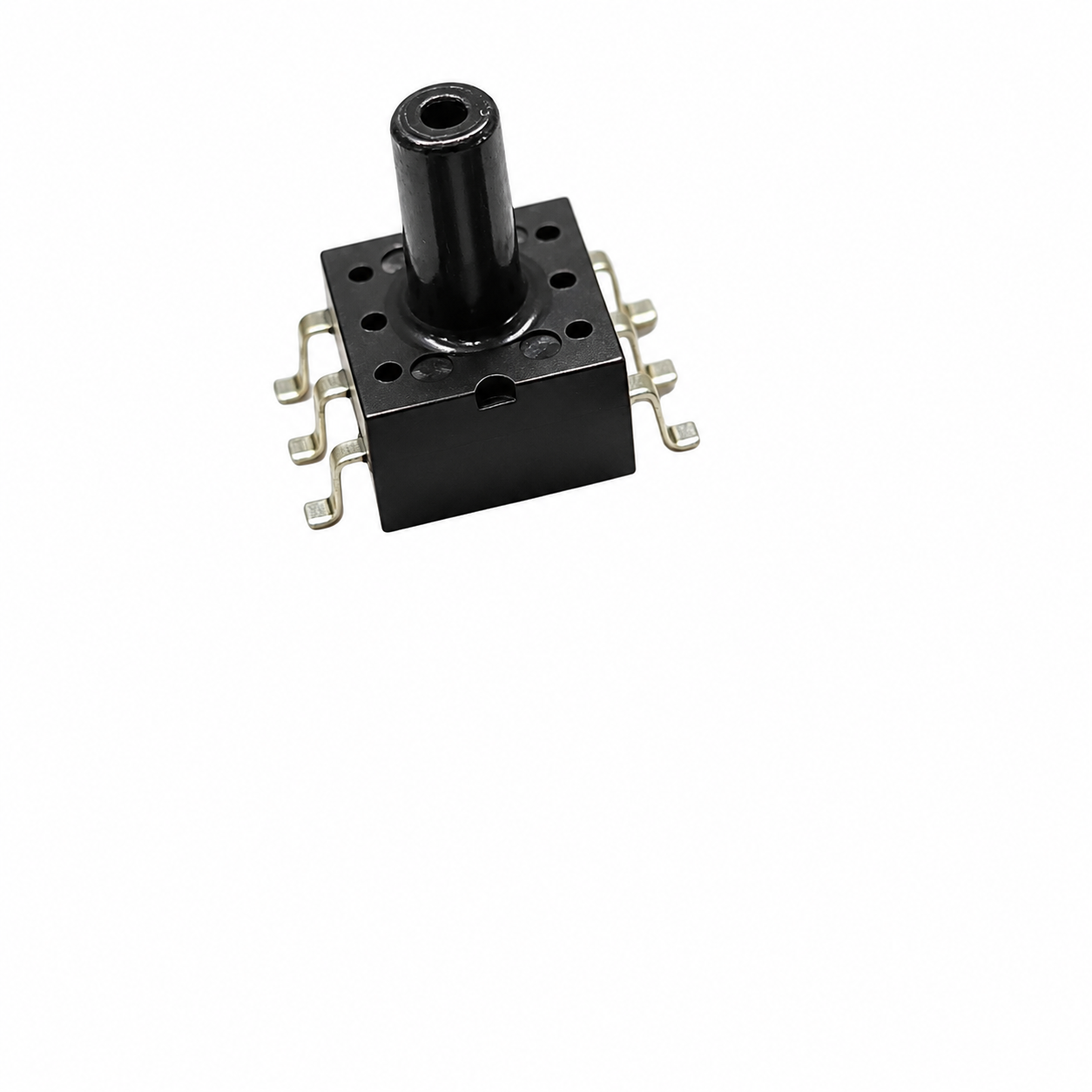
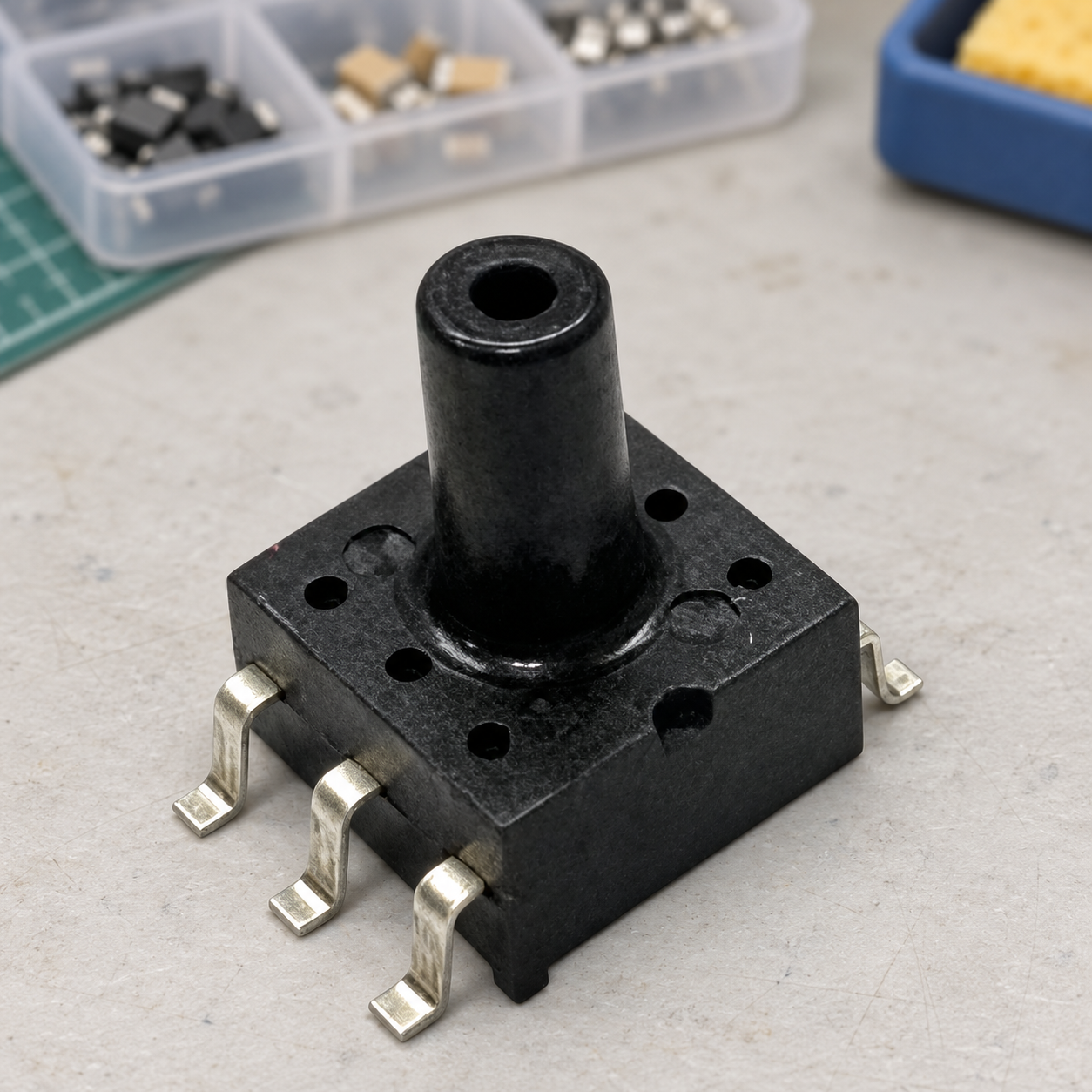
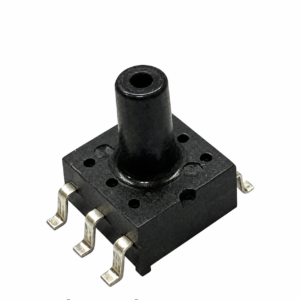
The PPK-QY9 is a surface-mount pressure sensor for PCB-based gas-pressure measurement. A MEMS piezoresistive sensing element and signal-conditioning circuitry provide calibrated pressure and temperature data through I2C.
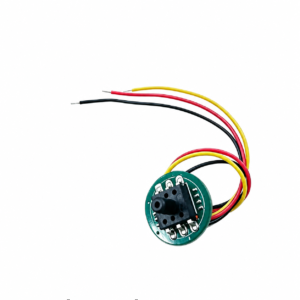
Its SOP6 package has a pressure port and six solder leads. This is a bare sensor component for integration into your own circuit, rather than a ready-to-connect sensor board or wired transmitter.
Key Features
- Three pressure-range versions for positive-only or negative-to-positive measurements.
- 1.8–3.6 V supply for low-voltage electronic designs.
- I2C standard and fast modes, up to 100 kHz and 400 kHz respectively.
- 24-bit pressure data and 16-bit temperature data.
- Temperature-compensated output for dry, non-corrosive gases.
- Low-power measurement and standby operation, subject to the stated sampling conditions.
Technical Specifications
| Model | PPK-QY9 |
|---|---|
| Package | SOP6, surface mount |
| Sensing principle | MEMS piezoresistive pressure sensing with signal conditioning |
| Medium | Dry, non-corrosive gases |
| Supply voltage | 1.8–3.6 V |
| Interface | I2C, standard mode up to 100 kHz or fast mode up to 400 kHz |
| Pressure data word | 24 bits |
| Temperature data word | 16 bits |
| Total error band | ±1% of span at 0–60°C |
| Working temperature | −40 to +85°C |
| Storage temperature | −40 to +125°C |
| Default I2C address | 0x78, 7-bit, if unchanged during calibration |
| Operating current | 9.5 μA typical at 1 Hz with minimum pressure and temperature oversampling |
| Standby current | 0.1 μA typical; 0.3 μA maximum |
| Current specification conditions | 3.3 V supply and 25°C unless otherwise specified |
Model Selection Guide
- | Version | Measurement range | How to choose |
- | Bipolar 100 kPa | −100 to +100 kPa | Select when the measurement crosses zero and both negative and positive pressure must be covered. |
- | Positive 200 kPa | 0 to 200 kPa | Select for positive-pressure measurements within 200 kPa. This version does not cover negative pressure. |
- | Positive 1000 kPa | 0 to 1000 kPa | Select for positive-pressure measurements up to 1 MPa. This version does not cover negative pressure. |
- All three versions use the same supply range, SOP6 package and I2C interface. Select the calibrated pressure range your design requires; a wider range is not a claim of better accuracy or resolution.
Applications
- PCB-based pressure instruments for dry, non-corrosive gases.
- Vacuum-pump and pneumatic-system monitoring using the appropriate pressure range.
- Embedded pressure measurement with a compatible I2C microcontroller.
Wiring / Installation
- | Pin | Name | Function |
- | 1 | NC | No connection |
- | 2 | SDA | I2C data |
- | 3 | SCL | I2C clock |
- | 4 | VDD | Positive supply, 1.8–3.6 V |
- | 5 | NC | No connection |
- | 6 | VSS | Ground |
- Use the package pinout and footprint drawing to establish orientation before laying out or soldering the component. Do not infer pin numbering from a product photo.
- The application circuit uses 4.7 kΩ pull-up resistors on SDA and SCL and a 0.1 μF supply bypass capacitor. Connect the bus to a compatible low-voltage host; do not apply a 5 V supply to the sensor.
- The default seven-bit address is 0x78 when it has not been changed during calibration. Do not enter the eight-bit write-address byte 0xF0 as a seven-bit device address.
- Start a calibrated measurement with command 0xAC. Wait until status bit 5 clears, then read the status byte, three pressure bytes and two temperature bytes. Convert the pressure count using the selected range and calibration endpoints. The I2C data is not a direct pressure value in kPa.
Compatibility & Important Notes
- Use only dry, non-corrosive gases. Keep liquids and condensation away from the sensing path.
- The 24-bit data word is a data format, not a promise of 24-bit effective accuracy. The ±1% span error band is specified at 0–60°C and must not be extended to the entire working-temperature range.
- Storage temperature is not the operating-temperature rating. Select the pressure range for normal operation rather than treating overpressure tolerance as an extra measurement range.


Reviews
There are no reviews yet