


Sensor de nivel de líquido sin contacto PPK-Y-28
Short description: External capacitive liquid level sensor for non-metallic tanks and pipes. Select 5 V, 12 V, or 24 V relay supply and normally open or normally closed output for fixed-point level detection.
Product Overview
The PPK-Y-28 detects a liquid level at one fixed point from outside a compatible non-metallic pipe or flat container wall. Choose the supply voltage that matches your DC system, then choose the relay behavior that fits the circuit you want to control.
Key Features
- External capacitive point-level detection with no direct contact with the liquid.
- Six selectable relay configurations: 5 V, 12 V, or 24 V DC, each with normally open or normally closed output.
- Designed for non-metallic pipes with an outside diameter of at least 11 mm and for suitable flat-wall containers.
- Specified 500 ms response time, 13 mA static current, ±1.5 mm level accuracy, and IP67 protection.
Model Selection Guide
Select the voltage first: it must match the DC supply available in your system. Then select NO or NC according to the relay contact behavior your circuit needs.
| Store option | Supply | Contact with no liquid detected | Contact when liquid is detected | Choose this when |
|---|---|---|---|---|
| 5 V Relay + Normally Open (NO) | DC 5 V | Open | Closes | Your circuit should close when liquid reaches the sensing point. |
| 5 V Relay + Normally Closed (NC) | DC 5 V | Closed | Opens | Your circuit should open when liquid reaches the sensing point. |
| 12 V Relay + Normally Open (NO) | DC 12 V | Open | Closes | Your circuit should close when liquid reaches the sensing point. |
| 12 V Relay + Normally Closed (NC) | DC 12 V | Closed | Opens | Your circuit should open when liquid reaches the sensing point. |
| 24 V Relay + Normally Open (NO) | DC 24 V | Open | Closes | Your circuit should close when liquid reaches the sensing point. |
| 24 V Relay + Normally Closed (NC) | DC 24 V | Closed | Opens | Your circuit should open when liquid reaches the sensing point. |
The NO/NC versions have a listed 2 A relay output. Confirm the connected load and local electrical requirements before wiring.
Applications
Suitable for fixed-point liquid-level detection on compatible non-metallic pipes and flat-wall containers where the sensing surface can be mounted tightly against the outside wall.
Technical Specifications
| Detection type | External capacitive point-level detection |
|---|---|
| Available relay configurations | DC 5 V, 12 V, or 24 V; normally open (NO) or normally closed (NC) |
| Relay output | 2 A listed for NO/NC versions |
| Compatible installation | Non-metallic pipes with outside diameter ≥11 mm, or suitable flat-wall containers |
| Response time | 500 ms |
| Static current | 13 mA |
| Level accuracy | ±1.5 mm |
| Operating temperature | -20 to 105 °C |
| Operating humidity | 5% to 100% |
| Ingress protection | IP67 |
| Cable length | 500 ±10 mm |
| Connector | XH2.54-4P |
| Housing material | PC+ABS-V0 |
Pipe Diameter and Wall Thickness
For pipe installations, choose a wall thickness appropriate to the pipe outside diameter.
| Pipe outside diameter | Specified sensing wall or tube wall thickness |
|---|---|
| 100 mm or larger | 20 ±3 mm |
| 80 to under 100 mm | 15 ±2 mm |
| 60 to under 80 mm | 12 ±1.5 mm |
| 40 to under 60 mm | 7 ±1 mm |
| 30 to under 40 mm | 5 ±1 mm |
| 20 to under 30 mm | 3 ±1 mm |
| 10 to under 20 mm | 1.5 ±0.5 mm |
Installation and Compatibility
- Mount the sensing surface tightly against a flat, uniform, insulating non-metallic wall. Keep any gap below 0.5 mm; no gap is preferred.
- Keep metal parts away from the sensing area.
- For the relay versions: brown is DC positive, blue is DC negative, yellow is signal output, and black is COM. Use the wiring diagram for the selected NO or NC circuit.
- Normal detection is specified for liquids with dynamic viscosity below 10 mPa·s. Detection may be affected from 10 to 30 mPa·s; liquids above 30 mPa·s are not suitable because material can adhere to the container wall.
- For outdoor installation, protect the sensor from direct sunlight, direct rainwater flow, and excessive heat. Keep it clean and inspect it regularly.
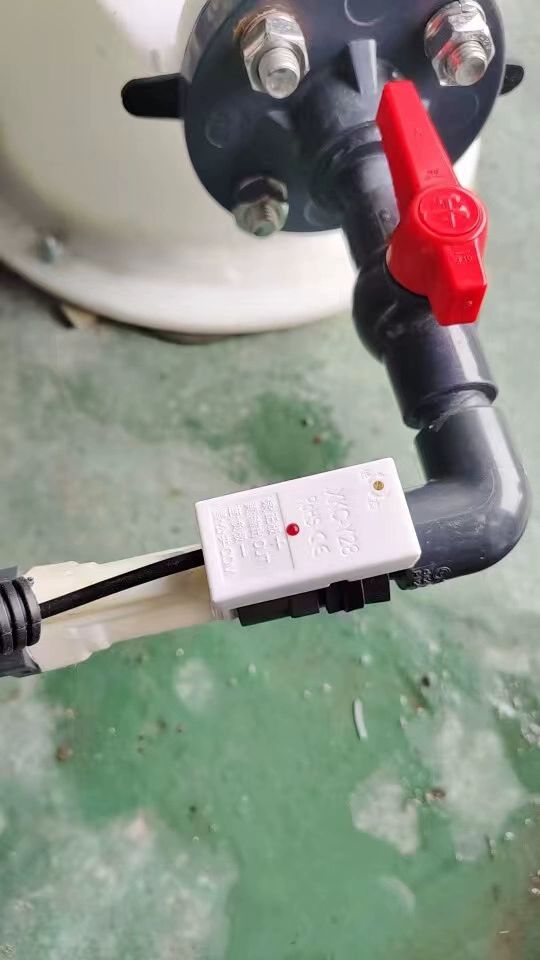


Initial tests look good. The light stays off when there’s no water, but turning up the sensitivity does the trick!